
DESIGNED FOR THE NEXT GENERATION OF CLINICIANS

Learn it. Understand it. Apply it.
FROM THE CLASSROOM TO CLINICAL PRACTICE
Connect what you learn to why it matters.
Learning healthcare can feel overwhelming.
One lecture covers pharmacology. Another introduces cardiac rhythms. Then come laboratory values, dosage calculations, airway management, shock, pediatrics, resuscitation, and dozens of clinical concepts that somehow need to come together when you begin caring for patients.
Heroes One helps bring those pieces together.
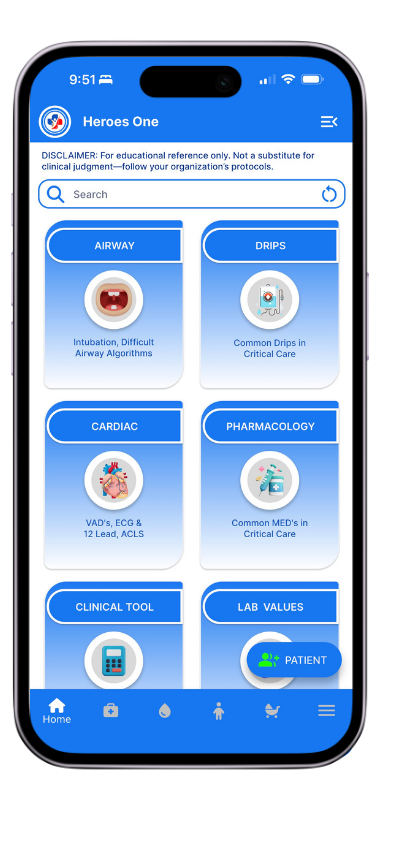
Instead of jumping between textbooks, notes, screenshots, calculators, websites, and multiple apps, students can access frequently needed clinical information through one organized reference.
Study the concept. Review the details. Understand the application. Build the foundation for clinical practice.
MORE THAN MEMORIZATION
Build understanding that follows you into practice.
Knowing the correct answer on an exam is important. Understanding why it’s the correct answer is what prepares you for the bedside.
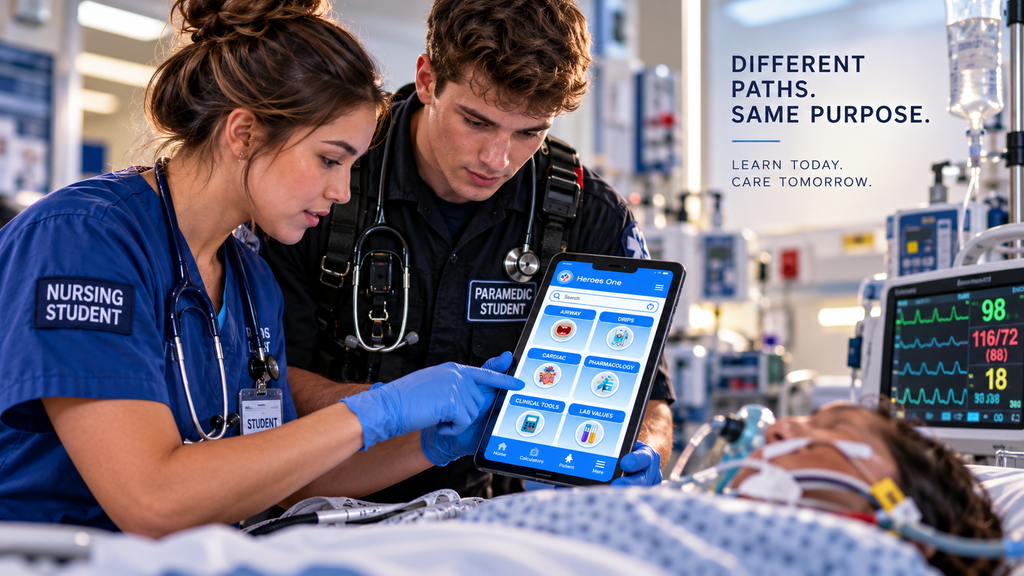
Heroes One is designed to help students reinforce the connections between assessment, pathophysiology, medications, calculations, laboratory findings, and clinical interventions. When you encounter an unfamiliar medication during clinicals, review it.
When your instructor discusses an abnormal laboratory value, look it up. When you’re practicing an airway scenario, review the relevant concepts.When a dosage calculation doesn’t make sense, work through it. When you encounter an ECG rhythm you’re still learning, reinforce what you’ve studied.
Learning becomes more meaningful when the information connects to something real.
YOUR CLINICAL REFERENCE WHILE YOU LEARN
Pharmacology & Medication References
Review commonly encountered medications, concentrations, dosing information, routes, indications, precautions, and other essential medication information while developing your pharmacology foundation.
Dosage & Clinical Calculators
Practice and verify commonly used clinical calculations while learning how patient weight, medication concentration, dose, and volume relate to one another.
Airway & Respiratory Care
Strengthen your understanding of airway assessment, oxygenation, ventilation, difficult airway concepts, advanced airway management, and related clinical topics.
ECG & Cardiac Resources
Reinforce rhythm recognition, 12-lead concepts, cardiovascular emergencies, and resuscitation principles as you progress from fundamentals to advanced care.
Laboratory Values
Quickly review commonly encountered laboratory tests, reference information, and their clinical significance while learning to connect abnormal results with the patient’s presentation.
Infusions & Critical-Care Concepts
Become familiar with commonly encountered infusions, concentrations, weight-based calculations, and critical-care medications before you’re expected to manage them independently.
Pediatric & Adult References
Develop confidence working across different patient populations and understand how assessment, medications, equipment, and interventions may change with age and weight.